TL;DR We give small models an explicit discourse model of how questions build on each other in a conversation, and train them to gather information with it. An 8B model trained this way gathers the missing information as often as GPT-5.6-Luna, with 38% fewer actions.
Motivating Questions
Can (L)LMs ask good questions? People have studied this for years (Rao & Daumé III, 2018; Aliannejadi et al., 2019; Li et al., 2024). Yet my conversations with Claude are full of irritating questions I never read. These are still valid questions (Mu et al., 2024; Siro et al., 2026). But are they good ones? If your labmate says someone ate the cake in the breakroom, both “Was it chocolate cake?” and “Who had a meeting in the breakroom last?” are valid. Only the second helps find the culprit.
Does a good asker need to be an expert? At a visit to the doctor, most of what leads to a diagnosis comes from the questions about your history. A well-known study from 1992 measured this (Peterson et al., 1992):
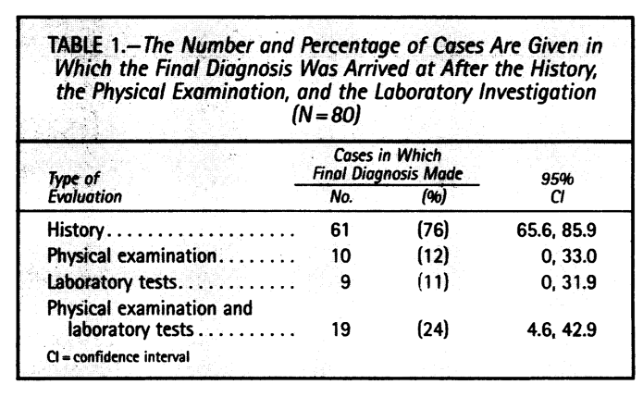
Asking the right questions and solving the case are separate skills.1 Can a small model learn the first, while a larger model handles the second?
Background
First, let’s motivate the discourse theory we draw from. When humans have conversations, we maintain a mental model of what inquiries we could ask at some point in the conversation. These change as the conversation proceeds. You might have a doubt that is answered by the next utterance from the speaker. On the other hand, some utterance could also raise more questions you could ask.
Linguists call these possible questions potential questions (PQs) (Onea, 2016). When you do decide to ask them, they become Questions Under Discussion (QUDs) (van Kuppevelt, 1995; Roberts, 2012). It’s not hard to see how this follows a tree-like structure. At this point, it’s best to use an animation to show how this tree structure evolves (click the arrows to cycle through):
These theories tell us which potential questions a conversation makes available. They don’t tell us which one to ask next. We:
- Operationalize the tree as a structure an LLM agent builds and updates as the conversation unfolds.
- Train small models to choose which PQ to pursue next, learning from the task itself.
Strategy of Inquiry
How do we operationalize a PQ-Tree? Leaving out the details from the paper, we borrow 4 properties of a good PQ from the discourse literature.2 These are shown in the animation below but here’s a simple explanation of each: Every question needs a parent that licenses asking it (Licensing). When you do ask a question, you need to make sure it’s relevant and that it actually helps answer the implicit big question. Questions need to be asked to the correct person. Checking the menu is something you do on your phone and not by asking Jo (Routing). Whenever you get an answer, you evaluate if the answer actually resolves the question you had (Answerhood). Finally, you close a section of your “tree” when all the leaf nodes (and thereby the parents) are resolved (Closure)!
The example below is the same one from before. We operationalize this tree structure as a JSON called the scoreboard (Lewis, 1979). This scoreboard has fields which correspond to each of these properties (seen by clicking them in the animation). Every turn, the agent grows its “tree” by adding new questions (or modifying by removing/closing old ones) as JSON objects!
So how do we learn this tree? We train information-gathering agents on demonstrations from a frontier model (which knows the facts to acquire and hence can generate a valid PQ-Tree).3 From these, the agents learn to build this tree and follow the properties we propose. Then we train with RL and reward conversations that gather more in fewer actions, i.e., learn the worth of good PQs. Those interested in the details might want to read the paper. The sections below instead focus on a more interesting question: Are the datasets/envs available today good enough to learn this task?
Environments to (not) learn Strategy of Inquiry (SOI) In
Before discussing the environment we choose to learn SOI in, it’s useful to see what kinds of environments are not useful to learn SOI in. Those that have used datasets/envs in this field would know that they look something like this (we refer to these as bags of questions):
- User states a question / asks to complete a task. Agent sometimes has other sources to get information from (apart from the user).
- Questions have between 1 and N missing facts. Facts are mostly disjoint. Answer to any one rarely changes the other. Sometimes, these facts are also fixed in advance.
- Reward is mostly coverage.
Why is this bad?
- It isn’t a test of conversational QA. It’s a test of (sometimes conditional) missing data imputation.
- Questions can be asked in any order! Reward ends up being the same for all.
In these settings, it is impossible to learn a strategy of inquiry.{: .pk} Hence we turn to building our own environment.
Our Env: SARA-Ask
Specifically, we turn to tax law cases from the SARA dataset (Holzenberger et al., 2020; Holzenberger & Van Durme, 2023). Why tax law specifically?
Picture a paralegal helping someone file their taxes. They gather information before the lawyer looks at the case: they ask the client about their life and look up the statutes that apply. Nobody knows in advance how many questions a case needs.4 Each answer decides what is worth asking next. Learning that the client is married raises questions about their spouse, and learning of a divorce sends you to the statutes on divorce. Plenty of facts about the client’s life also have no effect on the tax. A good paralegal asks as few questions as possible and still collects enough facts to work out the tax. That is a strategy of inquiry.
Tax law is also verifiable. With the tax code written as a program, a Prolog solver (Holzenberger et al., 2020) computes the exact tax owed from any set of facts. That gives us an RL reward for free, with no LLM judge.
Hence, we use the SARA dataset and convert it into a conversational environment where an agent interacts with a simulated user to gather information. A Prolog solver checks whether the collected information is sufficient or not. The below figure shows an example. Notice how few facts affect the gold amount. However, the agent still needs to collect dependent facts (and lookup statutes) to arrive at those questions.
Results
With prompting alone, SOI already beats Naive+JSON on all three metrics. Naive+JSON barely improves with SFT and GRPO, while SOI doubles its sufficiency5 from 16.3 to 33.0 after GRPO. The trained 8B model now matches GPT-5.6-Luna prompted with the scoreboard (33.0 vs 33.3) with 38% fewer actions.
Generalization
We only train on tax cases. On a dermatology diagnosis task, the 8B model still gathers more of the essential facts than GPT-5.6-Luna (66.3 vs 60.8). Ambig-SWE is a different story. Most of its facts sit in the code, and GPT-5.6-Luna reads the repository about 21 times per issue while our model reads it only 3 or 4 times. SOI still improves over the Naive baseline in that case.
Human evaluation
Three annotators tagged each step of a conversation with any problems they saw. They flagged 38.2% of Naive steps but only 12.6% of SOI steps, three times fewer. Every annotator gave SOI fewer tags of every type, and irrelevant steps almost disappear (12.5% to 1.2%).
Citation
TBD
Footnotes & References
References
- Aliannejadi, M., Zamani, H., Crestani, F. & Croft, W. B. (2019). Asking Clarifying Questions in Open-Domain Information-Seeking Conversations. SIGIR 2019.
- Holzenberger, N., Blair-Stanek, A. & Van Durme, B. (2020). A Dataset for Statutory Reasoning in Tax Law Entailment and Question Answering. NLLP Workshop @ KDD 2020.
- Holzenberger, N. & Van Durme, B. (2023). Connecting Symbolic Statutory Reasoning with Legal Information Extraction. NLLP Workshop 2023.
- Kirsh, D. & Maglio, P. (1994). On Distinguishing Epistemic from Pragmatic Action. Cognitive Science 18.
- Lewis, D. (1979). Scorekeeping in a Language Game. Journal of Philosophical Logic 8.
- Li, S. S., Balachandran, V., Feng, S., Ilgen, J. S., et al. (2024). MediQ: Question-Asking LLMs and a Benchmark for Reliable Interactive Clinical Reasoning. NeurIPS 2024.
- Mu, F., Shi, L., Wang, S., Yu, Z., Zhang, B., et al. (2024). ClarifyGPT: A Framework for Enhancing LLM-Based Code Generation via Requirements Clarification. Proceedings of the ACM on Software Engineering.
- Onea, E. (2016). Potential Questions at the Semantics-Pragmatics Interface. Brill.
- Peterson, M. C., Holbrook, J. H., Von Hales, D., Smith, N. L. & Staker, L. V. (1992). Contributions of the History, Physical Examination, and Laboratory Investigation in Making Medical Diagnoses. Western Journal of Medicine 156(2).
- Rao, S. & Daumé III, H. (2018). Learning to Ask Good Questions: Ranking Clarification Questions using Neural Expected Value of Perfect Information. ACL 2018.
- Roberts, C. (2012). Information Structure in Discourse: Towards an Integrated Formal Theory of Pragmatics. Semantics and Pragmatics 5.
- Siro, C., Yuan, Y., Aliannejadi, M. & de Rijke, M. (2026). AGENT-CQ: Automatic Generation and Evaluation of Clarifying Questions for Conversational Search with LLMs. ACM Transactions on Information Systems 44.
- van Kuppevelt, J. (1995). Discourse Structure, Topicality and Questioning. Journal of Linguistics 31.
-
Cognitive scientists draw the same line. Kirsh & Maglio (1994) separate epistemic actions, which uncover hidden information, from pragmatic actions, which move the task forward. ↩
-
We add a fifth, routing, ourselves. Discourse theory assumes two people talking. An agent can also look things up, so it has to decide where each question goes. ↩
-
The frontier model sees the case facts, but it may use them only to decide which questions to open and when to stop. It still asks every licensed question, even when it knows the answer is no. Otherwise the small model would learn to act on facts it cannot see. ↩
-
One could ask every possible question, but that wouldn’t make a very good paralegal (or a happy client). ↩
-
Sufficiency is the share of conversations where the facts the user revealed are enough for the solver to compute the correct tax. ↩